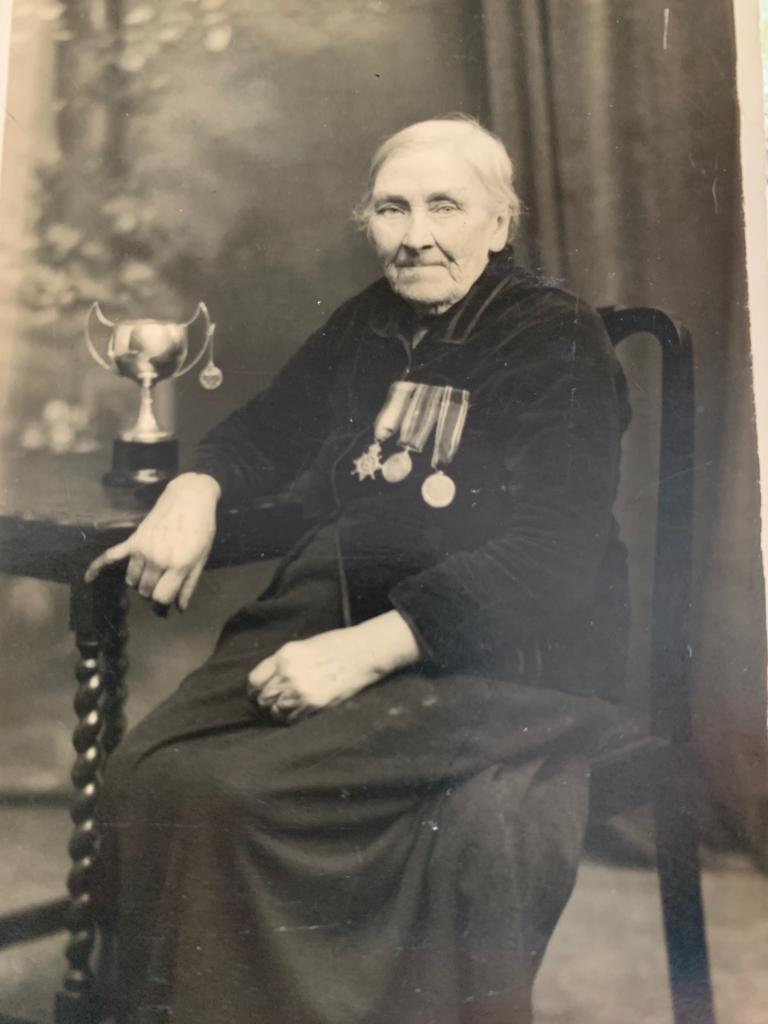
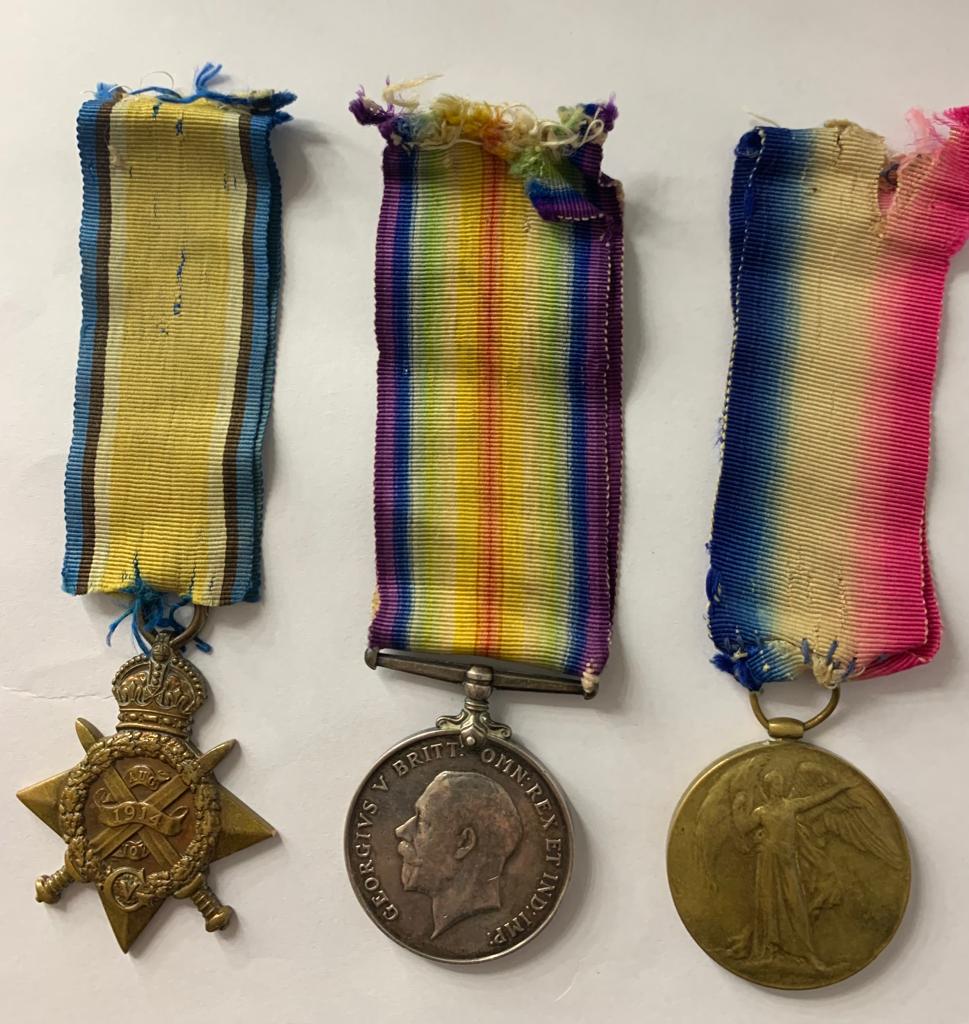
Pictured above : Mary Morgan wearing the World War One medals of her son, Thomas.
Elsewhere in this section, Breda Gaynor describes tracking down the grave of her relative, Thomas Masterson, an Irish born US soldier buried in Belgium.
Such is the close connection of north Dublin and the Great War, that Breda also had a neighbour with an uncle directly involved. His name was Thomas Morgan and he was the uncle of Breda’s next door neighbour, Doreen Morgan, who died some years ago.
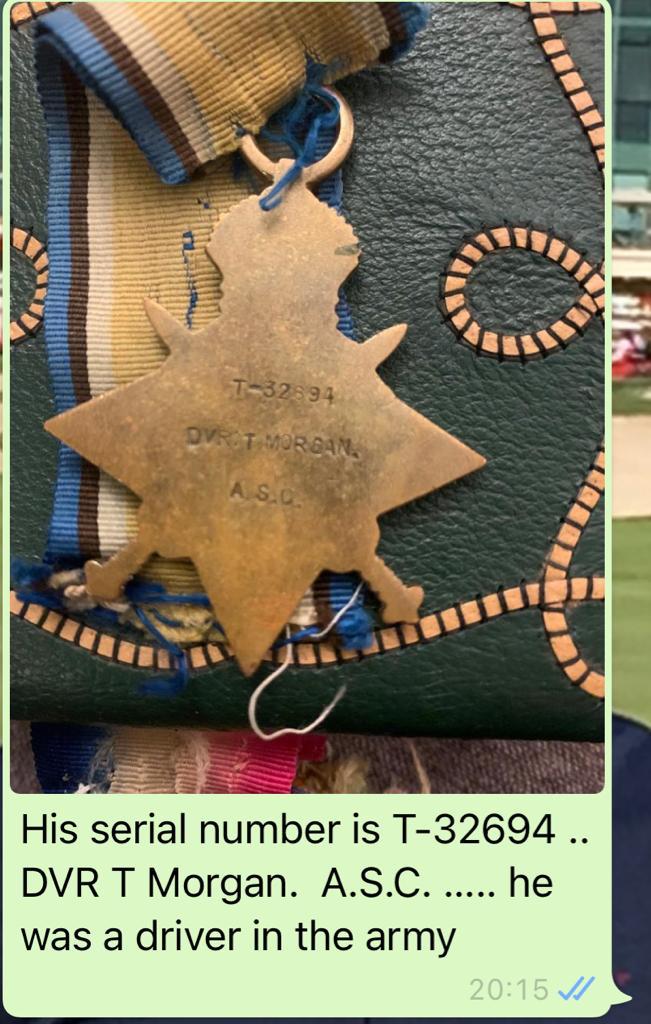
Thomas Morgan served with the Horse Unit, of the Army Services Corps (ASC) and survived the war. He landed in France on 22nd August 1914, with the 4th Division – at the very start of the war.
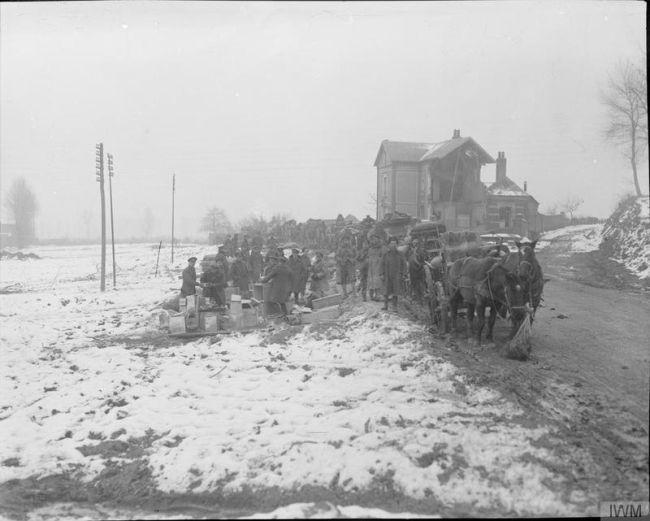
Morgan’s war medals have been passed down through his brother’s family, suggesting Thomas didn’t marry or have children of his own. Before enlisting, he lived with his family in Grenville Street, Dublin, near Mountjoy Square and worked as a Messenger.
The 1911 Census describes his father, Tommy, as an engine driver and his sister as a sales woman in the boot department of a large store. They sound like the metropolitan, commercially-active characters of James Joyce’s Ulysses, set in 1904.
Interestingly, there was another Thomas Morgan, from nearby Gloucester Street and listed as having died in the war, according to the A Street Near You website.
Gloucester Street, and the so called ‘Gloucester Diamond’ , was at the heart of Dublin’s inner city and was the source of many soldiers, including Royal Dublin Fusiliers.
Thomas Morgan would have been in good company, with a great many soldiers also coming from Mountjoy Square and its surrounding streets.
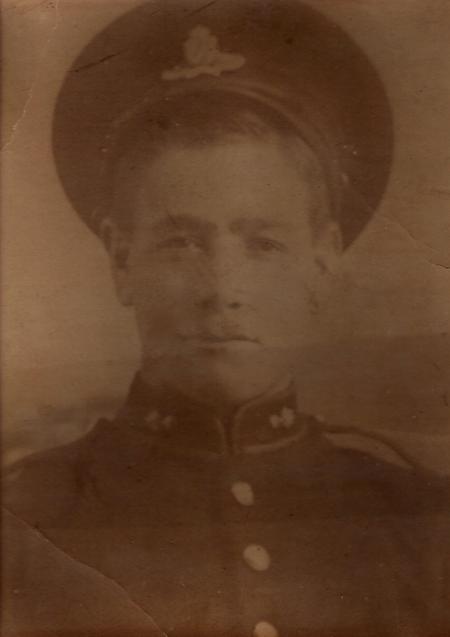
Below is a picture of John Wilson of 40 Mountjoy Square. He was a driver, with the Royal Field Artillery, which worked in tandem with the ASC. Wilson died on 20 September 1918 and is buried in Brie British cemetery in France.
The Army Services Corps (ASC), in which Thomas Morgan served, were the backbone of the whole war effort and, in many respects, they were the unsung heroes of the conflict.
Quite simply, without them there would have been no campaign. Soldiers cannot fight without food, equipment and ammunition, and cannot move without horses or vehicles. And it was the ASC’s job to provide all of this.
In supplying horses and motor vehicles, railways and waterways, the ASC performed ambitious feats of logistics and was a crucial factor in how the war was won.
Given the scale of the Great War, it was a colossal endeavour and the ASC would eventually number an extraordinary 10,547 officers and 315,334 men.
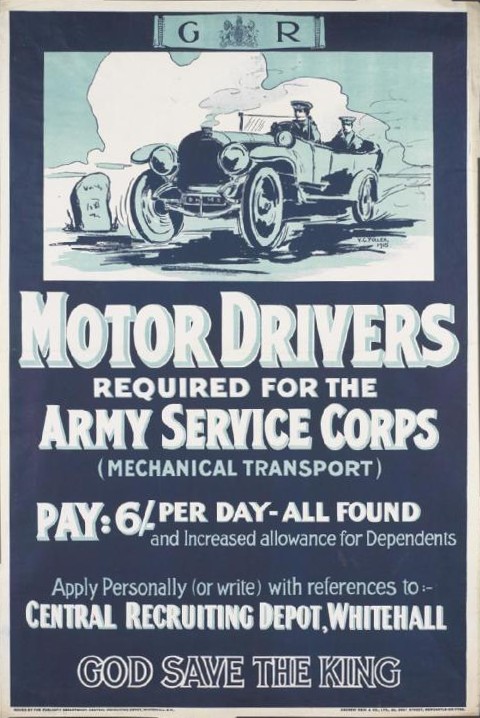
The largest element of the ASC was the Horse Transport section. The Mechanical Transport section, in which Morgan served, was also considerable.
In 1914, the British Army was already the most mechanised in the world and it retained this strength. By 1918, such strategic importance allowed it to maintain supplies as soldiers advanced over hard fought ground.
The ASC managed these so called Lines of Communication (logistics) and supplied heavy artillery through the Ammunition Columns, as well as managing Omnibus Companies, Motor Ambulance Convoys, and Bridging and Pontoon units.
The ASC Remounts Service was responsible for the provisioning of horses and mules. Ireland supplied many horses. There is even a Remount farm, in north Dublin, near Lusk, which trained a raised horses for the front. After Independence, however, it was burnt down leaving the locals without a major source of employment and equine industry.
The ASC also had Labour Companies. In France and Flanders it was realised in 1914 that the local authorities couldn’t supply civilian men for labouring duties, like unloading stores and equipment from ships. It was arranged to send 300 labourers, and soon specific Labour Companies were formed. Almost 21,000 skilled labourers and dock workers had joined by the end of 1915.
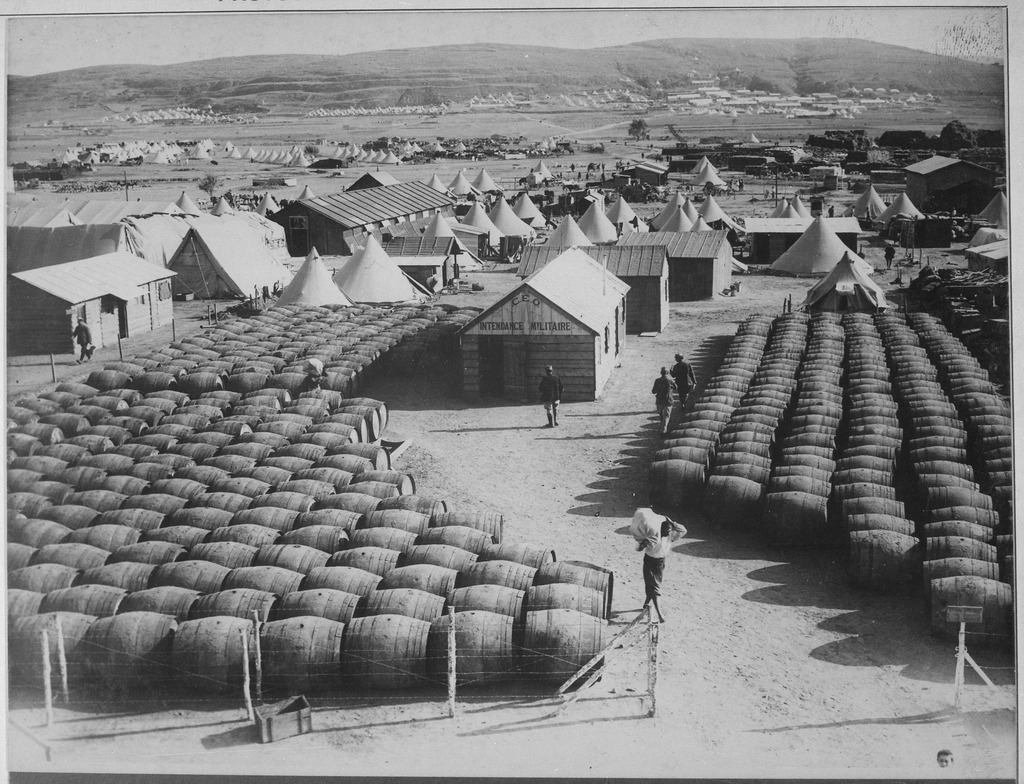
Picture above : Getting priorities right! The French army assembles wine barrels at the Allies camp in Mudros, Greece. Mudros was a base for operations in Gallipoli and held many Irish soldiers.
Base Depots like these were established for distribution and administration, and were used as the main supply stores for soldiers in the war zone.
The ASC also produced bread and meat for the troops, and its Supply Section ran Field Bakeries and Butcheries. Meanwhile, specialised Railway Labour Companies were quickly formed.
Basically, the ASC supervised the important military supply lines from port to front line, along with the camps, stores, dumps, workshops of the rear areas.
It is hard to comprehend just what this supply effort meant with an army that in France alone had been built up to over two million men. It was an extraordinary feat of logistics and Thomas Morgan from Mountjoy Square was a small but important part of that.
 The Lion and the Shamrock
I’m the granddaughter of Thomas Morgan he married Elizabeth o Shannasey an they had 6 Daughters an 1 son that was my great grandmother with the medals mary Morgan
LikeLike
That is very interesting Sadie. Thanks for that, and for making contact. It woukd be great to find out more about your relatives, and especially Thomas Morgan. Feel free to make contact. Eamondelaney2@gmail.com
LikeLike
Hi Eamon
Thanks so much for the lovely picture of our great grandmother with our grandfather Thomas Morgan’s medals I will email you tomorrow with whatever information we have.
Angela Morgan (Sadie Caffrey cousin)
LikeLike
Hi eamon, that’s a very interesting and close to my family history. I had 3 of my 4 great grandfathers fight in the first war and all 3 were from the north inner city and particularly mountjoy square and it’s surrounds. It must’ve taken some toll on that area if so many men went and probably didn’t come back the same person that left or at all.
Thanks for these stories, they give a personal insight into what was possibly going through their minds at this time.
Mark
LikeLike
Thanks for that, Mark and for the kind words. That’s fascinating about your family connections to World War One. I’d live to hear more. I could possibly help you to get more details. Feel free to email me. I’m also going to do another World War One walking tour in north Dublin soon. You’ll find that interesting. Cheers. Eamon eamondelaney2@gmail.com
LikeLike